
মোঃ আব্দুর রহমান
প্রভাষক
০৮ জুলাই, ২০২৬ ১২:৪৮ পূর্বাহ্ণ
প্রভাষক
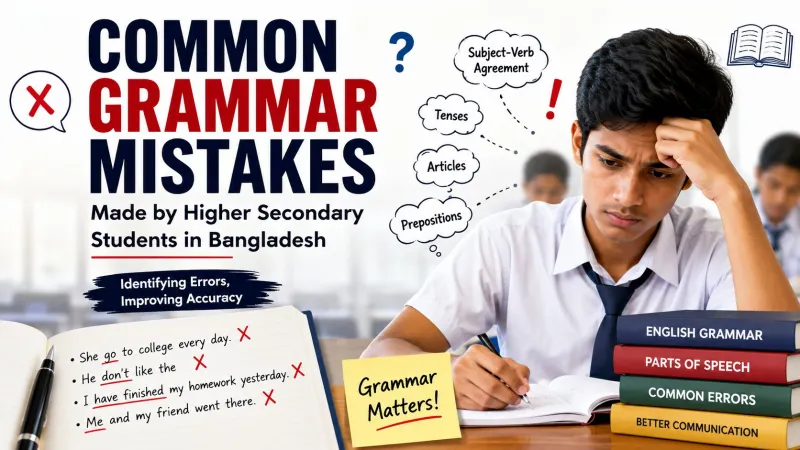
Common Grammar Mistakes Made by Higher Secondary Students in Bangladesh
Abstract
Grammar is an essential component of English language proficiency, enabling learners to communicate accurately and effectively. In Bangladesh, higher secondary students often demonstrate satisfactory reading and writing abilities but continue to struggle with grammatical accuracy. These recurring errors affect their academic performance, examination results, and confidence in using English in higher education and professional settings. This article explores the most common grammar mistakes made by higher secondary students in Bangladesh, examines their underlying causes, and proposes practical strategies that teachers and learners can adopt to improve grammatical competence.
Introduction
English serves as an international language of communication, higher education, technology, and employment. In Bangladesh, it is a compulsory subject throughout school and college education. Despite years of formal instruction, many higher secondary students struggle to use English grammar correctly in both written and spoken communication.
Grammar errors not only reduce the clarity of expression but also influence students' examination scores and overall language proficiency. Understanding these common mistakes is the first step toward developing effective teaching methods and helping students become confident users of English.
Common Grammar Mistakes
1. Incorrect Use of Tenses
One of the most frequent problems is the misuse of verb tenses. Students often fail to distinguish between present, past, and perfect tenses.
Incorrect:
Correct:
Many students rely on direct translation from Bangla, which contributes to tense-related errors.
2. Subject–Verb Agreement Errors
Students frequently use verbs that do not agree with their subjects.
Incorrect:
Correct:
Such mistakes usually result from inadequate understanding of singular and plural verb forms.
3. Misuse of Articles
The use of a, an, and the remains a major challenge because Bangla does not have an equivalent article system.
Incorrect:
Correct:
Students often omit articles or use them unnecessarily.
4. Confusion Between Parts of Speech
Learners frequently confuse nouns, verbs, adjectives, and adverbs.
Incorrect:
Correct:
Understanding word formation and sentence structure can significantly reduce these mistakes.
5. Preposition Errors
Prepositions are another difficult area because English prepositions rarely correspond directly to Bangla.
Incorrect:
Correct:
Students often memorize prepositions without understanding their proper usage.
6. Incorrect Use of Pronouns
Pronoun errors frequently appear in both speech and writing.
Incorrect:
Correct:
Students often confuse subject and object pronouns.
7. Run-on Sentences and Sentence Fragments
Many students write extremely long sentences without proper punctuation or conjunctions.
Incorrect:
Correct:
Learning sentence boundaries improves writing clarity.
8. Double Negatives
Students sometimes use two negatives in the same sentence, making the sentence grammatically incorrect.
Incorrect:
Correct:
9. Incorrect Word Order
Because Bangla sentence structure differs from English, students often transfer Bangla word order into English.
Incorrect:
Correct:
10. Misuse of Modal Verbs
Students often use modal verbs incorrectly.
Incorrect:
Correct:
Mastering modal verb patterns requires regular practice.
Causes of Grammar Mistakes
Several factors contribute to grammatical errors among higher secondary students in Bangladesh.
Impact on Learning
Persistent grammar mistakes have several negative consequences.
These issues highlight the importance of strengthening grammar instruction at the higher secondary level.
Strategies for Improvement
Teachers can adopt several practical approaches to reduce grammar mistakes.
Context-Based Grammar Teaching
Grammar should be taught through meaningful reading passages, conversations, and real-life situations rather than isolated rules.
Communicative Language Activities
Role plays, debates, presentations, and group discussions encourage students to apply grammar naturally.
Regular Error Analysis
Teachers should identify common classroom errors and discuss corrections collectively.
Extensive Reading
Reading newspapers, magazines, novels, and academic articles exposes learners to authentic grammatical structures.
Writing Practice
Students should write paragraphs, essays, emails, and reports regularly while receiving constructive feedback.
Technology Integration
Digital grammar platforms, mobile applications, and AI-powered writing assistants can provide immediate feedback and personalized learning opportunities.
Peer Review
Students can evaluate one another's writing, promoting collaborative learning and greater awareness of grammatical accuracy.
Recommendations
To improve grammar learning in Bangladesh's higher secondary education system, the following measures are recommended:
Conclusion
Grammar remains a fundamental element of English language proficiency, yet many higher secondary students in Bangladesh continue to make recurring grammatical errors. Most of these mistake’s stem from first-language interference, limited exposure to authentic English, and traditional teaching methods that emphasize memorization over communication. By adopting learner-centered instructional approaches, integrating technology into grammar instruction, and providing continuous opportunities for meaningful language use, teachers can significantly improve students' grammatical competence. Strengthening grammar education will ultimately prepare learners for higher education, professional success, and effective participation in the global community.
References
Azar, B. S., & Hagen, S. A. (2017). Understanding and Using English Grammar (5th ed.). Pearson.
Brown, H. D. (2007). Principles of Language Learning and Teaching (5th ed.). Pearson Education.
Ellis, R. (2008). The Study of Second Language Acquisition (2nd ed.). Oxford University Press.
Richards, J. C., & Rodgers, T. S. (2014). Approaches and Methods in Language Teaching (3rd ed.). Cambridge University Press.
Swan, M. (2016). Practical English Usage (4th ed.). Oxford University Press.
Thornbury, S. (1999). How to Teach Grammar. Pearson Education.
Ur, P. (2012). A Course in English Language Teaching (2nd ed.). Cambridge University Press.
Md. Abdur Rahman
Lecturer in English
Nowhata Govt. Degree College
Paba, Rajshahi
01711062210



৪
৬ মন্তব্য