
মোঃ আব্দুর রহমান
প্রভাষক

০৯ জুলাই, ২০২৬ ০৩:৪৮ অপরাহ্ণ
প্রভাষক
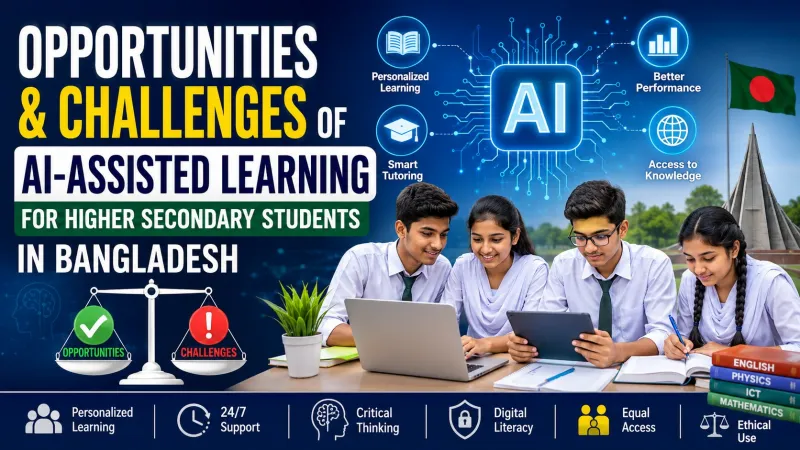
Opportunities and Challenges of AI-Assisted Learning for Higher Secondary Students in Bangladesh
Abstract
Artificial Intelligence (AI) is transforming education worldwide by offering personalized learning experiences, intelligent tutoring systems, automated assessment, and instant access to educational resources. In Bangladesh, AI-assisted learning is gradually becoming an important component of higher secondary education as students increasingly use platforms such as ChatGPT, Google Gemini, Grammarly, and adaptive learning applications. While AI creates significant opportunities to improve English proficiency, academic performance, digital literacy, and self-directed learning, it also presents challenges including academic dishonesty, misinformation, unequal access to technology, privacy concerns, and overdependence on AI-generated content. This article explores the opportunities and challenges of AI-assisted learning for higher secondary students in Bangladesh and offers practical recommendations for educators, policymakers, and learners to ensure the ethical and effective integration of AI into the educational system.
Introduction
The rapid advancement of Artificial Intelligence (AI) has reshaped various sectors, including healthcare, finance, agriculture, and education. In the educational context, AI is revolutionizing teaching and learning by making education more accessible, interactive, and personalized.
Bangladesh has embraced digital transformation through initiatives such as "Smart Bangladesh 2041," encouraging the integration of technology into education. Following the COVID-19 pandemic, digital learning platforms became increasingly popular among higher secondary students. AI-powered educational tools now help learners improve writing, solve mathematical problems, practice English communication, summarize academic texts, and prepare for examinations.
Despite these advantages, AI adoption in Bangladesh also raises concerns regarding ethical use, digital inequality, critical thinking, and the preparedness of teachers and institutions. Therefore, understanding both the opportunities and challenges is essential for maximizing AI's educational potential.
The Growing Role of AI in Education
AI-assisted learning refers to the use of intelligent computer systems that support students in acquiring knowledge, practicing skills, receiving feedback, and solving academic problems.
Popular AI tools used by Bangladeshi students include:
These technologies enable students to learn independently beyond classroom boundaries.
Opportunities of AI-Assisted Learning
1. Personalized Learning Experience
Every student learns differently. AI systems analyze learning behavior and provide customized lessons based on individual strengths and weaknesses.
Students who struggle with grammar can receive targeted exercises, while advanced learners can access more challenging materials.
2. Improved English Language Learning
English remains one of the most challenging subjects for many higher secondary students in Bangladesh. AI-powered applications can support students by:
These features encourage continuous language practice beyond classroom hours.
3. Twenty-Four-Hour Learning Support
Unlike traditional classrooms, AI tools are available anytime.
Students can ask questions late at night, revise difficult concepts before examinations, or clarify lessons immediately without waiting for teacher assistance.
4. Enhanced Critical Thinking Through Guided Learning
When used properly, AI can encourage students to compare ideas, evaluate evidence, and explore multiple perspectives rather than memorizing information. Teachers can design AI-assisted activities that promote analytical thinking and problem-solving.
5. Faster Access to Learning Resources
AI quickly summarizes textbooks, explains difficult concepts, creates quizzes, and recommends relevant educational materials.
This saves valuable study time and increases learning efficiency.
6. Inclusive Learning
AI technologies can assist learners with diverse educational needs through:
Such features help create a more inclusive educational environment.
7. Better Examination Preparation
AI helps students prepare for public examinations by generating:
Students receive immediate feedback, allowing continuous improvement.
8. Development of Digital Skills
Using AI responsibly helps students develop essential twenty-first-century skills such as:
These competencies are increasingly valuable in higher education and employment.
Challenges of AI-Assisted Learning
1. Academic Dishonesty
One of the greatest concerns is students submitting AI-generated assignments as their own work.
Excessive dependence on AI may reduce originality and academic integrity.
2. Decline in Critical Thinking
If students rely entirely on AI-generated answers, they may stop analyzing problems independently.
Learning becomes passive instead of reflective.
3. Digital Divide
Many rural students lack:
4. Misinformation and Inaccurate Responses
Although AI provides useful information, it occasionally produces incorrect, outdated, or fabricated content.
Students must verify information using reliable academic sources.
5. Limited Teacher Readiness
Many teachers have not yet received adequate training in AI integration.
Without professional development, AI may remain underutilized or be used ineffectively in classrooms.
6. Data Privacy and Security
AI applications often collect user information.
Students should understand:
7. Language and Cultural Limitations
Although AI performs well in English, support for Bangla academic content is still developing.
Local curriculum alignment and culturally relevant educational resources require further improvement.
8. Cost and Infrastructure Constraints
Some advanced AI platforms require paid subscriptions.
Schools with limited technological infrastructure may struggle to integrate AI into regular classroom activities.
Recommendations
To maximize AI's educational benefits, the following strategies should be considered:
Future Prospects
Bangladesh's vision of becoming a Smart Bangladesh presents a significant opportunity to integrate AI into education. As AI technologies continue to evolve, they may transform classrooms through intelligent tutoring systems, adaptive assessments, virtual laboratories, multilingual learning platforms, and personalized educational pathways.
However, successful implementation will depend on balanced policies that combine technological innovation with human-centered teaching. Teachers will remain indispensable in nurturing creativity, ethics, emotional intelligence, and critical thinking—qualities that AI cannot replace.
Conclusion
AI-assisted learning has the potential to revolutionize higher secondary education in Bangladesh by making learning more personalized, accessible, and engaging. It can strengthen English language learning, improve examination preparation, and foster essential digital competencies. Nevertheless, challenges such as academic dishonesty, digital inequality, misinformation, and inadequate teacher training must be addressed to ensure responsible adoption.
Rather than replacing teachers, AI should be viewed as a supportive educational partner that enhances teaching and learning. With thoughtful policies, ethical practices, and equitable access to technology, Bangladesh can harness AI to build a more inclusive, innovative, and future-ready education system.
References
Holmes, W., Bialik, M., & Fadel, C. (2019). Artificial Intelligence in Education: Promises and Implications for Teaching and Learning. Center for Curriculum Redesign.
Luckin, R. (2018). Machine Learning and Human Intelligence: The Future of Education for the 21st Century. UCL Institute of Education Press.
UNESCO. (2023). Guidance for Generative AI in Education and Research.
OECD. (2021). Artificial Intelligence and the Future of Skills.
Ministry of Education, Bangladesh. National Education Policy.
Government of Bangladesh. Smart Bangladesh 2041 Vision.
Md. Abdur Rahman
Lecturer in English
Nowhata Govt. Degree College
Paba, Rajshahi
01711062210




১
২ মন্তব্য